
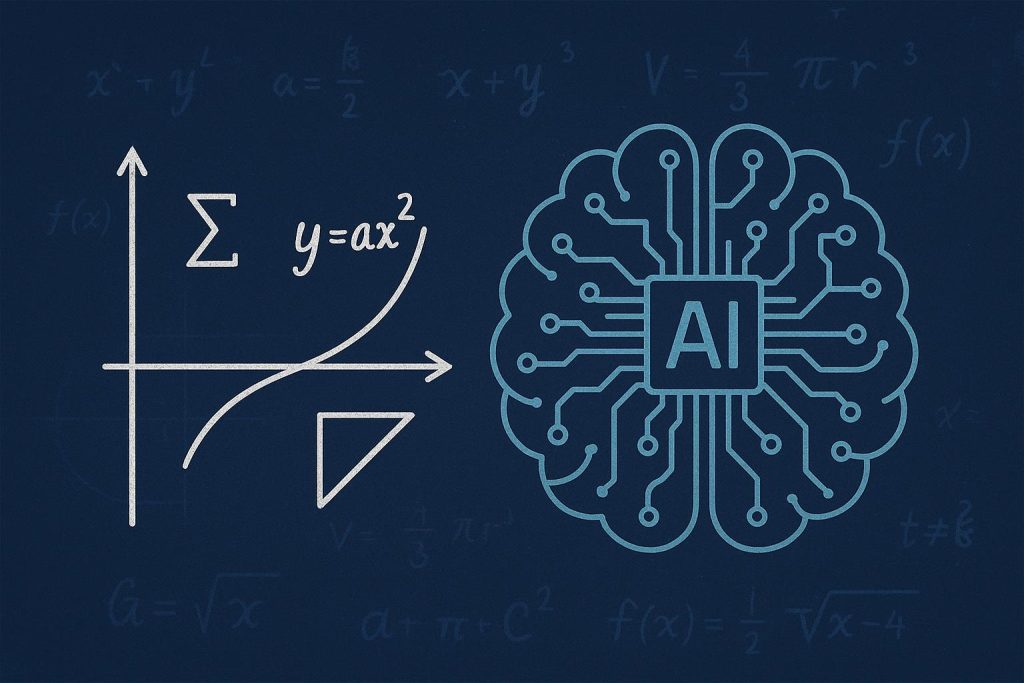
In an era often defined by algorithms, neural networks, and large language models, it is easy to assume that machines have surpassed human reasoning, especially when it comes to mathematics. Yet, behind every intelligent system lies a foundational truth: AI does not replace mathematical thinking; it depends on it. Mathematics is not merely a technical discipline within AI development but the backbone that enables systems to reason, generalize, detect patterns, and make decisions.
From probability theory to optimization, from logic to numerical reasoning, mathematical expertise remains essential for building reliable, accurate, and trustworthy AI. As AI adoption accelerates across industries, a new opportunity is emerging for those with strong mathematical skills: contributing directly to the development, evaluation, and refinement of AI systems within a global community of Math experts.
Contents
THE HIDDEN ROLE OF MATH IN MODERN AI
While AI applications are often showcased through conversational interfaces, image generation, or automation tools, what lies beneath the surface is a web of mathematical structures. Models rely on equations, statistical inference, logical consistency, and formal reasoning to function correctly. However, these systems are not perfect. They can hallucinate results, misapply logic, or struggle with edge cases (particularly when it comes to complex mathematical reasoning). That’s where human expertise plays a crucial role. Humans help AI:
- Validate mathematical correctness
- Evaluate reasoning steps, not just final answers
- Detect inconsistencies or flawed logic
- Improve model robustness across different problem types
This collaboration between human reasoning and machine computation is not temporary but it is fundamental to the future of AI. For those interested in applying their mathematical skills beyond traditional academic or corporate paths, platforms like the global community of Math experts of Outlier are creating new ways to contribute to AI development while working flexibly and remotely.
WHY AI NEEDS HUMAN MATHEMATICAL JUDGMENT
One of the most persistent myths around AI is that more data automatically leads to better intelligence. In mathematics, this assumption breaks down quickly. AI models may generate plausible-looking equations or reasoning chains, but plausibility is not correctness. Without rigorous validation, subtle errors can propagate, undermining trust in AI outputs, especially in high-stakes domains like science, finance, or education. Human mathematicians bring something machines still lack:
- Deep conceptual understanding
- The ability to evaluate reasoning structure
- Awareness of assumptions and constraints
- Sensitivity to edge cases and counterexamples
These qualities are difficult to encode but essential for ensuring mathematical accuracy. As a result, math experts are increasingly involved in tasks such as reviewing model outputs, testing reasoning robustness, helping AI systems learn better problem-solving strategies.
A NEW KIND OF MATHEMATICAL WORK
Traditionally, math-heavy careers were limited to academia, engineering, finance, or research institutions. AI has expanded this landscape dramatically. Today, math experts can apply their skills in new contexts:
- Evaluating AI-generated solutions
- Improving symbolic and numerical reasoning
- Stress-testing models with complex problem sets
- Helping AI generalize across different mathematical domains
What also makes this shift particularly compelling is flexibility. Many of these roles are remote, project-based, and adaptable to different schedules, offering an alternative for professionals seeking autonomy without sacrificing intellectual depth. This evolution reflects a broader change in how expertise is valued. Rather than being defined by job titles or institutions, impact is increasingly measured by the ability to apply knowledge where it matters most.
THE GLOBAL NATURE OF AI COLLABORATION
AI development is no longer confined to a handful of tech hubs. It is inherently global, drawing on diverse perspectives, educational backgrounds, and problem-solving approaches. Mathematics (as a universal language) plays a unique role in this ecosystem. A well-structured proof, a sound logical argument, or a carefully reasoned solution transcends cultural and geographic boundaries. By working within international AI initiatives, math experts gain exposure to a wide range of problem types and reasoning styles, enhancing both personal growth and collective model quality. This distributed collaboration strengthens AI systems by reducing bias and increasing robustness.
TRUST, ACCURACY, AND THE LONG-TERM IMPACT OF MATH EXPERTS
As AI systems become embedded in everyday tools, trust becomes a defining factor. Users may not see the underlying mathematics, but they rely on its correctness implicitly. Errors in reasoning – especially mathematical ones – can have cascading consequences. That’s why human oversight remains essential, particularly in evaluation and refinement stages. Math experts serve as guardians of correctness, helping ensure that AI outputs are not just fluent, but valid. This work contributes to more than just short-term accuracy. It builds long-term confidence in AI systems, reinforcing their credibility and adoption across domains.
A MEANINGFUL WAY TO SHAPE THE FUTURE OF AI
For mathematicians, this moment represents a rare intersection of relevance and opportunity. The skills developed through years of study (liken logical rigor, abstraction, analytical thinking etc..) are now directly shaping one of the most influential technologies of our time. Working with AI is not about surrendering human intelligence to machines. It is about extending it, guiding it, and ensuring it reflects the standards we expect from intelligent systems.
Far from being diminished by AI, mathematics has become more vital than ever. They provide the structure, discipline, and reasoning that allow intelligent systems to move beyond approximation toward understanding. As AI continues to evolve, the role of math experts will only grow, quietly but powerfully influencing how machines think, learn, and interact with the world. In the end, the future of AI is not just written in code. It is written in logic, clarity, and human mathematical insight.
