
Contents
- 1 Key Takeaways
- 2 The Science Behind UV Spot Curing: Precision and Performance
- 3 Key Applications of UV Spot Curing: A Deep Dive
- 4 Choosing the Right UV Spot Curing System: Expert Insights
- 5 Future Trends in UV Curing Technology: What to Watch For
- 6 FAQ
- 6.1 What industries can benefit from UV spot curing technology?
- 6.2 How does UV curing compare to other curing methods?
- 6.3 What is the role of photoinitiators in UV curing?
- 6.4 Can UV curing systems be used for both adhesive and coating applications?
- 6.5 What maintenance is required for UV curing systems?
- 6.6 How do UV curing systems support automation in manufacturing?
- 6.7 What new developments are on the horizon for UV curing technology?
- 6.8 How can a company assess its need for a UV spot curing system?
Key Takeaways
UV light plays a vital role in curing processes by initiating chemical reactions that swiftly cure adhesives, coatings, and inks. This not only enhances quality but also improves efficiency across various industries.
Spot curing technology allows manufacturers to focus energy delivery with precision, striking a balance between speed and detail—an essential factor for meeting stringent quality standards.
In the medical device sector, manufacturers gain substantial advantages from UV spot curing systems. These systems guarantee strong adhesion and biocompatibility, both crucial for ensuring patient safety and product reliability.
Within the electronics manufacturing industry, UV spot curing supports intricate assemblies, permitting rapid adjustments to design changes while maintaining dependable connections.
Selecting the right UV spot curing system involves evaluating substrate compatibility, as well as specific intensity and wavelength requirements, alongside the potential for future scalability.
Advancements in UV LED technology are anticipated to refine curing methods, providing cleaner, energy-efficient options with instant curing capabilities and reduced production cycles.
Sustainability is gaining significance in UV curing applications, prompting manufacturers to implement eco-friendly materials and practices that align with evolving market trends and consumer expectations.
The Science Behind UV Spot Curing: Precision and Performance
Understanding UV Light’s Role in Curing
In manufacturing, UV light serves a pivotal function in the curing process. It’s intriguing how ultraviolet radiation ignites complex chemical reactions, enabling rapid curing of adhesives, coatings, and inks. This goes beyond mere technicality; it profoundly influences quality and efficiency across numerous sectors. While the use of UV light for curing isn’t new, its application in targeted situations is advancing quickly.
When UV light hits a material treated with photoinitiators, it triggers a significant transformation. These photoinitiators decompose upon exposure to UV radiation, generating reactive species that interact with the material to form cross-linking. The end result? A durable and resilient product. In fast-paced industries like electronics, speed is everything. A rapid curing process could spell the difference between timely delivery and substantial financial setbacks. Thus, grasping this mechanism is vital for industry players looking to refine their manufacturing workflows.
The Mechanisms of Spot Curing Technology
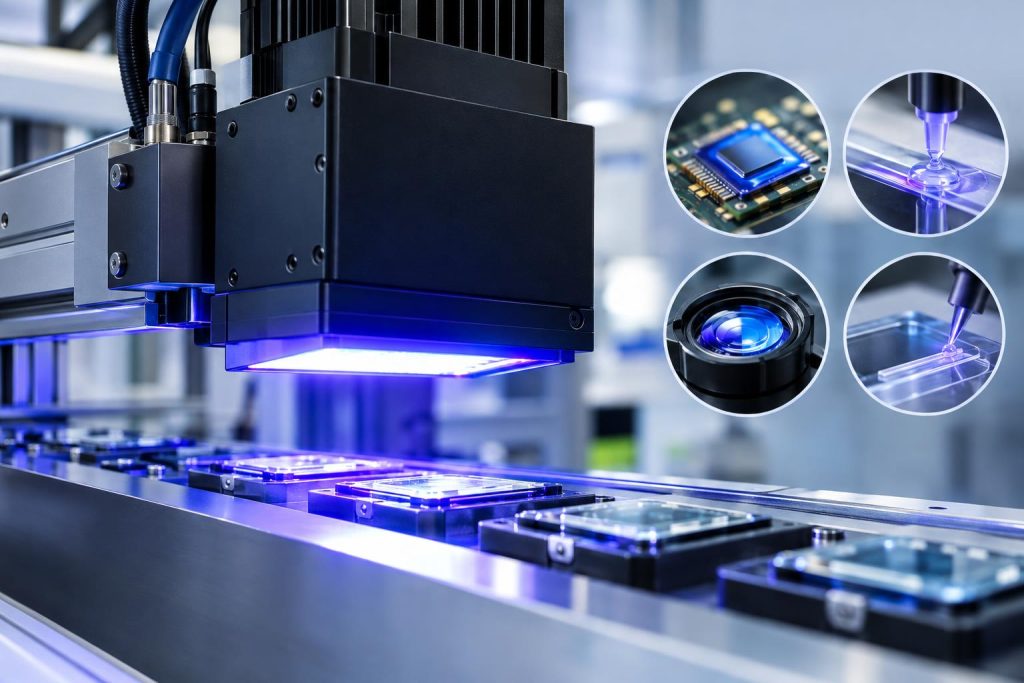
Spot curing technology represents a refined method to deliver energy precisely where necessary. By concentrating UV light on specific areas, manufacturers achieve an impressive equilibrium of speed and precision. This approach is often compared to the distinction between a laser-cut and a sweeping motion. The former allows for meticulous detail, ensuring that even the most rigorous applications meet stringent quality benchmarks.
In practical terms, UV spot curing systems employ meticulously designed optics and state-of-the-art UV lamp technologies. This encompasses everything from custom lenses to specialized reflector configurations, all intended to enhance light distribution. Moreover, the ability to tailor the curing process for diverse substrates adds a significant layer of versatility. Metals, plastics, and ceramics can all be adequately cured using specific techniques designed for their individual characteristics. Consistency across various materials highlights the robustness of this technology.
Key Applications of UV Spot Curing: A Deep Dive
Transforming Medical Device Assembly with UV Technology
Medical device manufacturers are often the first to acknowledge the compelling advantages of UV spot curing systems. In a field where reliability is paramount, UV curing upholds adhesion integrity and biocompatibility without long wait times. In this context, timing often proves critical—delays can incur hefty costs, making product safety essential.
Take applications like bonding into account, where secure attachment of components is necessary. UV light facilitates the immediate setting of adhesive bonds, expediting assembly and rigorous testing. This guarantees that quality control can occur without downtime in the production chain. Efficiency in medical manufacturing typically translates to better patient safety and improved outcomes.
- Rapid curing essential for fast-paced environments.
- Ensures strong, biocompatible bonds in sensitive applications.
- Enhances product quality through reliable curing processes.
Enhancing Electronics Manufacturing: From Circuit Boards to Components
The electronics sector, a powerhouse of innovation, benefits greatly from UV spot curing. As components shrink and become more intricate, the demand for precise applications intensifies. Consider how UV curing adeptly tackles these complexities, ensuring reliable connections in circuit boards without compromising adjacent structures.
Manufacturers frequently encounter rapid design changes. UV curing offers an agile response, adapting seamlessly to shifting assembly needs. The capability for instant curing, even on delicate components, alleviates risks associated with last-minute modifications. Reliability in electronics fosters consumer trust, and integrating UV technology enables manufacturers to sustain a competitive advantage.
- Supports complex assemblies with intricate connections.
- Adapts to rapid design changes without compromising quality.
- Improves overall production efficacy.
Choosing the Right UV Spot Curing System: Expert Insights
Top Considerations for Selecting a UV Curing Solution
Choosing the appropriate UV spot curing system isn’t merely about selecting any solution on the market. It demands a thoughtful assessment of specific needs and capabilities. To start, professionals must grasp the applications and substrates they engage with. Each substrate may react differently to UV light, making it essential to find a system that accommodates those variations.
Next, the intensity and wavelength of the UV light deserve careful consideration. Different applications might require specific settings to achieve peak results. For instance, thicker substrates may need deeper penetration, while delicate electronics call for more nuanced control. Understanding this enables businesses to customize their UV solutions effectively.
- Assess substrate compatibility with UV technology.
- Determine required UV intensity and wavelength.
- Evaluate system scalability for future demands.
FAQs on System Specifications and Performance Metrics
Numerous manufacturers share the same inquiries regarding UV curing systems. What performance metrics truly matter? Which specifications should they focus on while assessing options?
Prospective buyers often contemplate the curing speed, energy consumption, and ease of operation. Importantly, assessing user-friendliness of the system is crucial. Operators must be capable of utilizing it effectively, saving time and minimizing errors. Moreover, evaluating the safety features inherent in a UV system is also necessary. Are there sufficient shielding and monitoring mechanisms in place to protect operators?
Future Trends in UV Curing Technology: What to Watch For
Advancements in UV LED Technology and Their Implications
Ongoing advancements in UV LED technology are set to transform the future of curing methods. Traditional mercury lamps are steadily falling out of favor due to limitations in light intensity and energy inefficiency. In contrast, UV LEDs provide a cleaner and more energy-efficient alternative with extended lifespans.
Perhaps the most notable consequence is the diminished need for warm-up times. Systems employing UV LEDs can achieve optimal curing almost instantaneously. This enhances production efficiency while also increasing operational flexibility. Expect this technology to become a standard in the coming years as businesses invest in more efficient systems to satisfy growing consumer demands.
- Decreased energy costs with LED technology.
- Shorter cycle times due to instant curing capabilities.
- Adoption of more environmentally-friendly practices.
The Growing Importance of Sustainability in Curing Applications
As businesses increasingly prioritize sustainability, the UV curing field is no exception. The emphasis on using environmentally-friendly materials is steadily gaining traction among manufacturers eager to take advantage of these trends. Companies are reassessing their processes, aiming for methods that minimize harmful emissions and waste.
With advancements in UV curing technologies, manufacturing professionals can now select materials and systems that align with sustainability goals while preserving product integrity. Investing in UV spot curing systems often leads to reduced waste and energy consumption, congruent with both market trends and consumer expectations.
UV spot curing systems are poised to play an increasingly important role in manufacturing sectors where precision is critical. Ongoing innovation and a commitment to enhancing quality create a promising outlook for industries embracing this technology.
FAQ
What industries can benefit from UV spot curing technology?
UV spot curing technology offers advantages across numerous industries, such as automotive, aerospace, and packaging. Manufacturers in these fields typically require both precision and efficiency, and the rapid curing process facilitates high-quality, reliable production.
How does UV curing compare to other curing methods?
When evaluating UV curing against traditional techniques like thermal curing, evidence suggests that UV technology provides faster curing times and energy efficiency. Notably, this enhanced efficiency doesn’t compromise quality; in fact, finished products often exhibit superior durability and performance.
What is the role of photoinitiators in UV curing?
Photoinitiators are essential in UV curing as they absorb UV light and kickstart the chemical reactions necessary for curing. Their decomposition upon exposure creates free radicals, which then promote cross-linking within the adhesive or coating, leading to stronger bonds.
Can UV curing systems be used for both adhesive and coating applications?
Absolutely, UV curing systems are versatile for both adhesive and coating uses. The ability to adjust parameters such as intensity and wavelength empowers manufacturers to customize the process based on whether they’re bonding or coating surfaces.
What maintenance is required for UV curing systems?
Routine maintenance is crucial for ensuring the longevity and performance of UV curing systems. This includes cleaning lamps and optics, examining for wear and tear, and verifying that UV output remains within specified limits to preserve optimal curing efficacy.
How do UV curing systems support automation in manufacturing?
UV curing systems can be seamlessly integrated into automated manufacturing lines, boosting production speed and efficiency. By providing immediate curing, these systems cut down idle times and help sustain a smooth workflow—vital for high-volume production environments.
What new developments are on the horizon for UV curing technology?
Emerging advancements in UV curing technology include innovations in LED systems that promise even greater energy efficiency and adaptability. Research indicates that the push for sustainability will drive further innovation, resulting in novel materials and processes that minimize environmental impact while enhancing effectiveness.
How can a company assess its need for a UV spot curing system?
Companies ought to evaluate their distinct production needs, factoring in material compatibility and desired curing speed. A thorough analysis of current processes can reveal inefficiencies, facilitating the determination of whether a UV spot curing system could elevate overall productivity and quality.
