
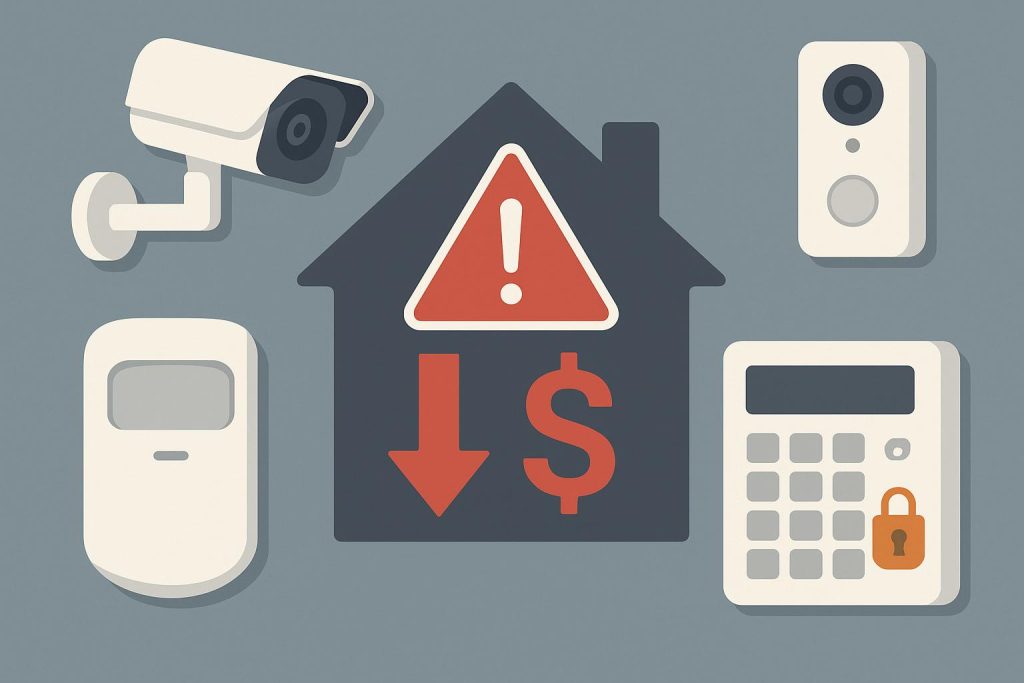
There is something for everyone in the home security and automation arena. Plenty of consumers are more than willing to invest in brand-name packages that come complete with professional installation and 24/7 remote monitoring. Others prefer the DIY route but still choose a complete package. There is a third option that comes with a serious downside: piecemeal home security.
Piecemeal home security and automation involve buying individual devices and installing them without a central hub to tie everything together. There are valid reasons for starting this way. Although I left piecemeal home security behind a couple of years ago, I did start with just two devices and a mobile app. Here is the problem I ran into: upselling.
Contents
Aggressive Upselling Through a Mobile App
I had quite forgotten my experience with piecemeal home security. However, I just ran across an article on the PC World website by contributor Michael Ansaldo. His post reminded me of my bad experience from my piecemeal days.
Ansaldo’s article was essentially a review of a new dual-lens exterior security camera with a whole bunch of bells and whistles. It offers a lot of great features any home security buff would enjoy. What it doesn’t offer is its own mobile app. Instead, it piggybacks off a third-party app that acts is a platform for many off-brand cameras.
I will not mention the app here. If you want to know what it is, go read the article yourself. I will say that Ansaldo’s only critique of the camera in question was the mobile app. It worked well enough, but the features of the free version were limited. The big downside is the apps constant reminders to upgrade to paid features. Apparently, the upselling is aggressive enough to turn consumers off.
Ads in the Mobile Space Are Common
Ads in the mobile space are common. None of us are surprised by them. But I will say that I have experienced some apps with ads so aggressive that the apps were nearly impossible to use. I once had a file manager I knew was a freemium app when I first got it. Initially, the ads were reasonable. But a couple of years into it, everything changed.
The ads got so aggressive that I was spending more time tapping to close them down than actually moving files around. I would have paid for the app if its features were worth the price. But they were not. So I ultimately scrapped it and found a replacement.
The ads in my old security app were the same way. I used the app primarily to manage two cameras. But every time I wanted to check my feeds, I had to wade through a layer of ads. The ads were so bad that they finally motivated me to abandon my piecemeal home security model in favor of going with an established platform and building a new system from there.
No More Piecemeal: The Other Options
Upselling is a reality in the piecemeal world. If you are going to go with dozens of individual devices and the mobile apps that come with them, expect at least some amount of upselling. Most of your major brands keep upselling to a minimum. But the off-brands tend to have a lot less shame. They upsell aggressively.
So what are your other options? Your first option is to go with a premium brand that offers the equipment, installation, and monthly monitoring in a single package. Vivint Home Security is a good example. They offer free installation with every system they sell. They also offer around-the-clock monitoring. You can get a package without monitoring if you want to handle that part yourself.
The advantage here is knowing you will have a system that works out of the box. And given that it’s installed by professionals, it is one less headache you don’t have to worry about. You just need to be home when the installation tech arrives. They will handle everything else.
Yet another option is the brand-name DIY option. Here you buy a branded system you can install yourself. One of the leading names in this space is SimpliSafe. You get the same type of equipment as you would with Vivint. You can even pay for remote monitoring if you want. The big difference is that you install and maintain everything yourself.
Open Source Home Security and Automation
There is yet another option for the adventurous and tech-minded: trading in your piecemeal system for open source home security. This is where I eventually ended up. I don’t mind either of the previously mentioned options, but I am a tinkerer by nature. Playing with tech is one of my hobbies. So it seemed natural for me to take up open-source home security.
I use an open-source platform installed on an old laptop that was doing nothing but gathering dust. My platform supports dozens of brands and thousands of devices. In my system, I have two different brands of smart plugs. I chose one of those brands for my wall switches as well. I also have two cameras. One is an actual security camera, and the other is a repurposed webcam that now keeps an eye on my front door.
Going the open-source route is not for the faint of heart or those afraid of digging into software and wireless networks. You need to know your way around wireless technologies to make it work. You also need to learn some coding if you hope to create customized routines. Yet, it is doable if you have the willingness to learn and some time to put into it.
At any rate, the one thing that all of these alternatives have in common is a lack of aggressive upselling. Piecemeal home security was fine in the sense that at helped me get my feet wet, but the upselling wasn’t good. That is why I eventually left the piecemeal approach for what has proven to be a better option.
