
Dyan Gershman is a New York City corporate lawyer with more than 25 years of experience advising U.S. and international clients on complex legal and transactional matters. As founder and partner of Gershman Law, PLLC, she draws on senior-level experience gained at an elite global law firm and at two Fortune 50 multinational companies, where she handled mergers and acquisitions, joint ventures, strategic alliances, technology licensing, and other corporate transactions. Her background includes extensive work on cross-border matters and advising organizations operating under U.S. and international legal frameworks. This professional foundation provides relevant context for examining public legal analyses such as the New York City Bar Association’s overview of recent United States actions against Venezuelan vessels. The NYC Bar statement raises constitutional and international law issues tied to executive authority, use of military force, and due process, areas that intersect with broader principles governing lawful governmental action and accountability.
NYC Bar Overview of U.S. Actions against Venezuelan Vessels
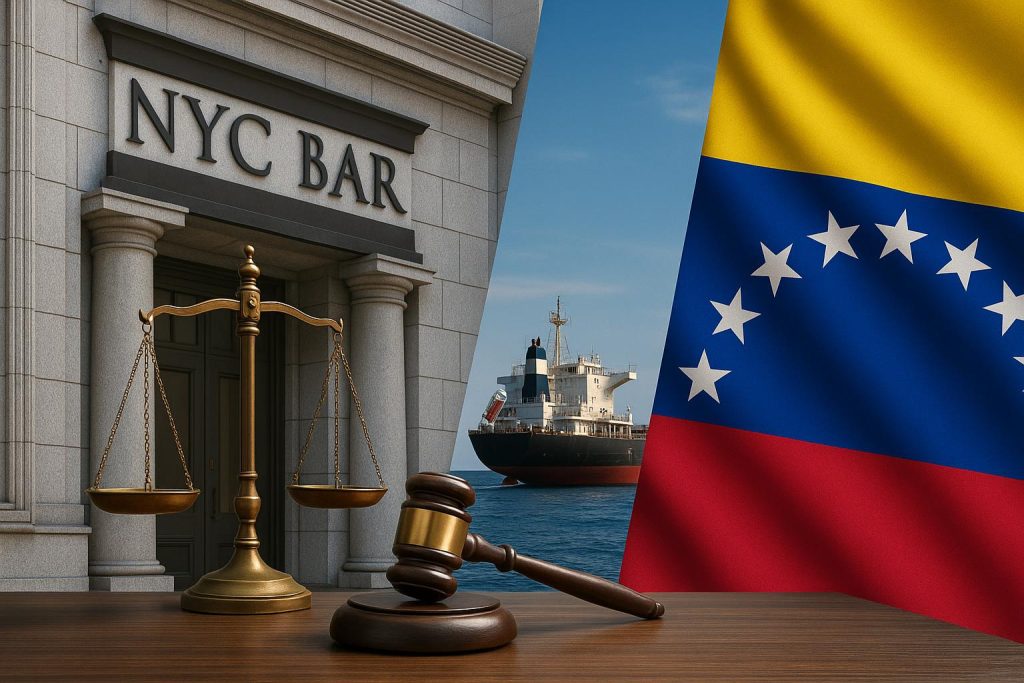
In October 2025, the New York City Bar Association (NYC Bar) released a statement describing the various actions carried out by the United States government against Venezuelan vessels in September and early October. The series of attacks began in September, when President Donald J. Trump ordered three military strikes against private vessels in open waters flying Venezuelan flags. The attacks resulted in the deaths of at least 17 people and the destruction or sinking of the ships.
The U.S. government launched a fourth attack on October 3, resulting in at least four additional deaths. None of these attacks were authorized under U.S. law, and each of the maneuvers appear to fulfill the criteria of unlawful summary executions, which run afoul of both Constitutional and international law. While the President has described the victims as drug traffickers and terrorists, the government has provided no such evidence. Furthermore, even if these claims prove true, they still provide no grounds for the unlawful executions.
Similarly, the President has made claims to Congress that the United States has initiated an “armed conflict” with drug cartels around the world, but the military actions remain unlawful without congressional authorization. Rather than seeking authorization and providing evidence for his claims of terrorism and drug trafficking, the President has instead foreshadowed more attacks on Venezuelan vessels, with the possibility of escalating from attacks on civilian boats to maneuvers against the Venezuelan government.
In addition to risking open hostilities with Venezuela and neighboring countries, these actions could set a dangerous precedent for continued misuse of America’s military forces in foreign territories or within the United States.
Governments that truly wish to curb domestic and foreign narcotic sales can do so under United States and international law. Similarly, various laws enable the U.S. government to act against individuals and organizations suspected of terrorist activities, including in foreign waters. These channels allot the accused traffickers and terrorists due process under U.S. law. Numerous American presidents have used these laws to mitigate the illegal trafficking of narcotics into the country, but the President’s actions against private Venezuelan vessels fall well short of these standards.
As part of its statement, the NYC Bar has called on the executive branch of the government to abort all future plans for unauthorized military actions in foreign waters, in addition to urging Congress to assert its powers and acknowledge that the President cannot use American military forces, particularly against foreign civilians, without lawful congressional approval.
The NYC Bar continued its statement by outlining the various transgressions of U.S. and international law. For example, the president cannot order any use of force via the military without meeting constitutional standards, particularly those laid out in Article I, Section 8 of the Constitution, which specifically describes the declaration of war as a power belonging to Congress, not to the president. Alternatively, the president may authorize the use of military force in instances of self-defense, which, once again, do not apply to the attacks on civilian vessels in Venezuela.
Even recently expanded military action legislation fails to provide the current president with grounds for these unprecedented attacks. For instance, the Authorization for Use of Military Force (2001 congressional resolution) allows the president to use military force against nations with ties to the Al Qaeda terrorist organization, such as Libya and Syria. Venezuela has no known ties to Al Qaeda or any affiliated groups.
About Dyan Gershman
Dyan Gershman is a corporate lawyer admitted in New York and Florida with over 25 years of legal experience. She is the founder and partner of Gershman Law, PLLC, where she advises clients on corporate law, mergers and acquisitions, strategic alliances, technology and intellectual property licensing, and commercial transactions. Her career includes prior roles at Jones Day, Bristol-Myers Squibb, and General Electric, where she led significant U.S. and cross-border transactions. She earned her juris doctor from Boston College Law School and her undergraduate degree from Colorado College.
